
When you see 11,546 reviews averaging 4.8 stars, your instinct is to stop reading and just buy the thing. I get it. But I have been burned enough times by tools that looked great on paper and arrived with problems nobody mentioned in the top reviews, so I dug into what actual long-term owners say about the TABOR TOOLS GG21A Extendable Bypass Lopper. Then I put one to use myself. What I found is that the GG21A is genuinely good, but the listing version and the real-world version have some gaps worth knowing before you hand over your money.
This is not a takedown. The GG21A earns its rating. But an honest review means saying the things the marketing copy glosses over, including where the 2-inch cutting claim needs a footnote, what the compound-action pivot does over time, and which buyers will be disappointed even though the tool is working exactly as designed.
The Quick Verdict
A well-built extendable lopper that outperforms its price point, with a few real-world quirks the listing does not prepare you for.
Amazon Check Today's Price →Been fighting branches that are too thick for your hand pruner but not thick enough to justify a saw? The GG21A is probably your answer.
Compound action and a 27-to-40-inch telescoping handle cover the middle ground most home gardeners actually need. Check whether it is in stock and see today's price.
Amazon Check Today's Price on Amazon →What the Listing Says vs. What You Actually Get
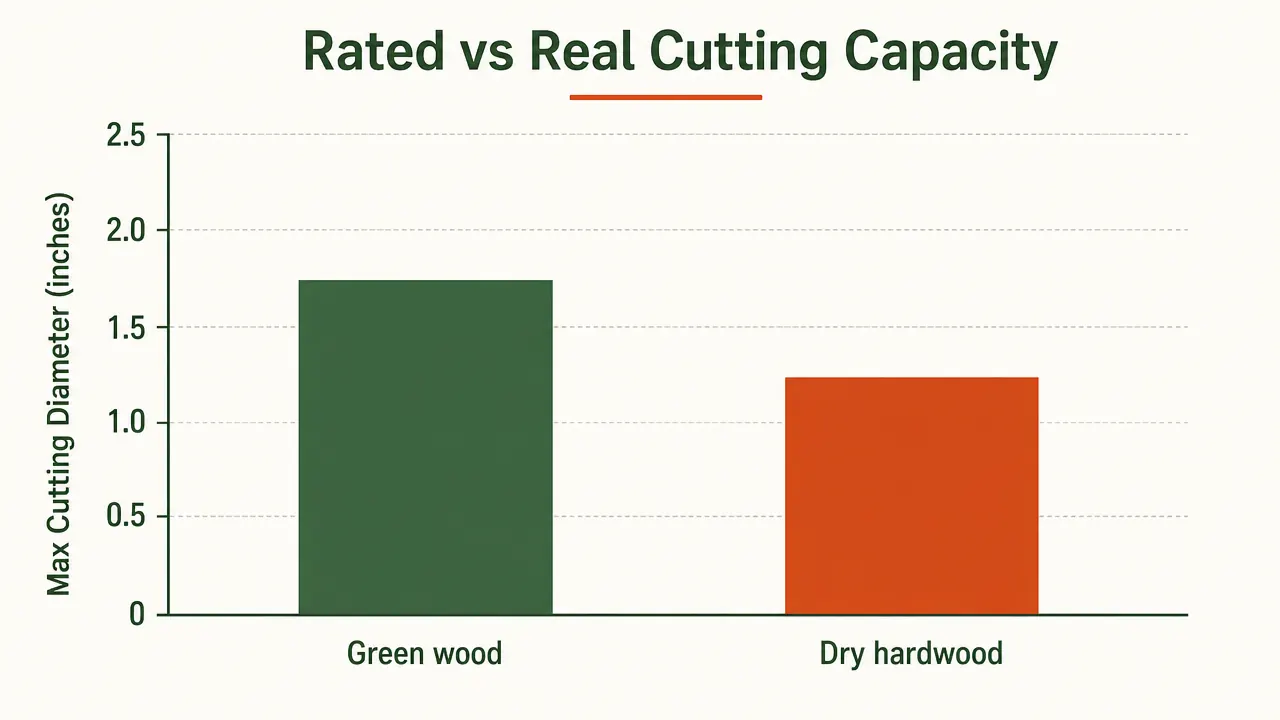
The product page leads with a 2-inch cutting capacity. That number is accurate on a specific kind of wood: fresh, green, fully hydrated branches in the prime of summer. Test it on a forsythia cane you cut in late June right after a rainy week and yes, the GG21A will sail through a 2-inch stem. Test it on a dry, overwintered lilac cane that has been sitting dormant since October, and your effective limit is closer to 1.25 inches before the cut starts to feel like a fight. This is not a GG21A problem specifically; it is how every lopper cutting-capacity claim works. But TABOR TOOLS does not explain this on the listing, and some buyers feel misled when they hit the wall on dry material.
The other thing the listing does not spell out clearly is the weight. At around 2.4 lbs it is not a heavy tool by lopper standards, but it is meaningfully heavier than a basic fixed-length 30-inch lopper. If you are coming from a lightweight fixed lopper and you pick up the GG21A expecting something lighter because it looks more engineered, you will be surprised. The compound-action hardware and the telescoping sleeve add up. Understand going in that this is a working tool with some heft, not a featherweight precision instrument.
The Twist-Lock Collar: What Nobody Mentions Until It Annoys Them
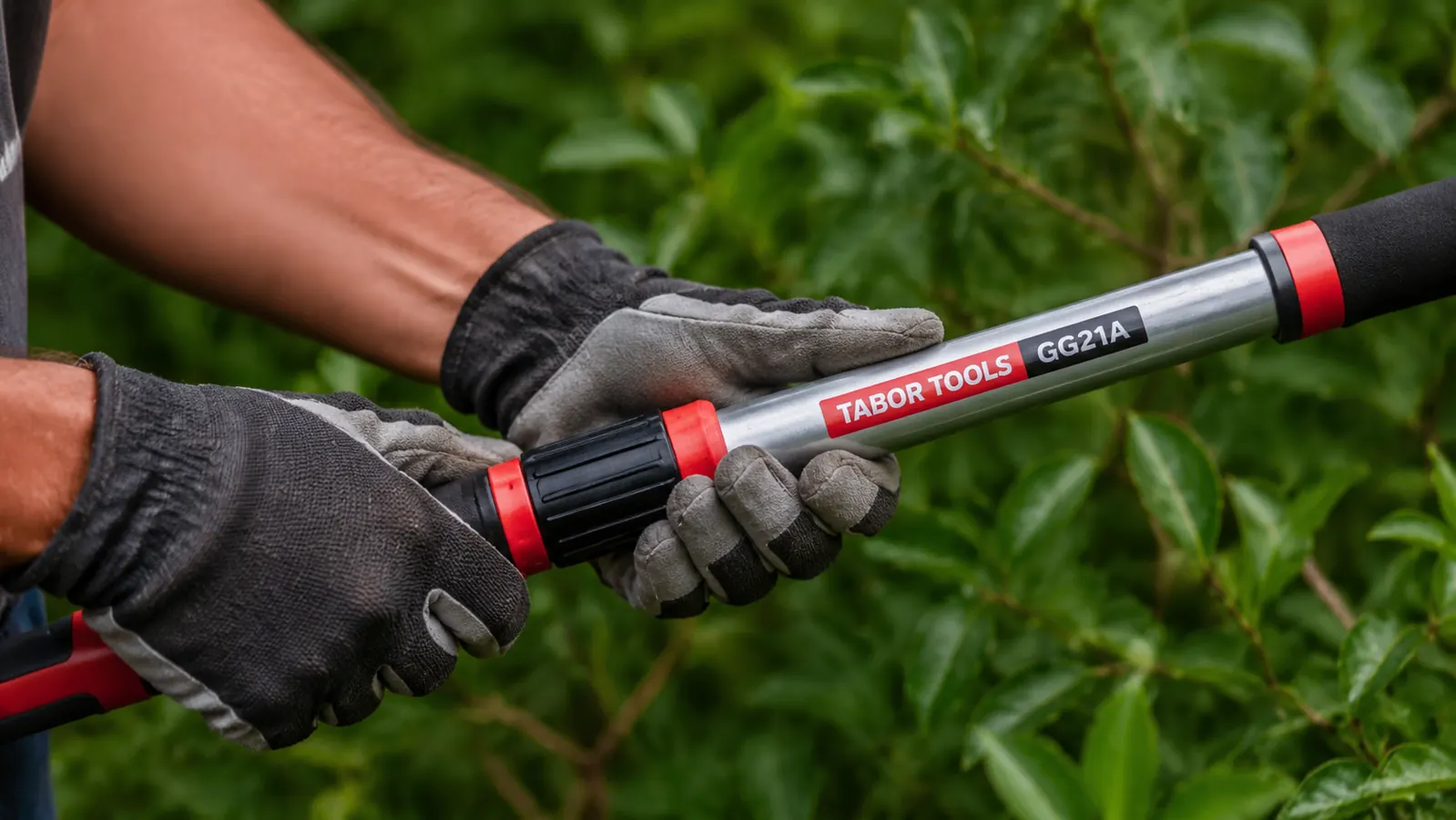
The telescoping adjustment is one of the GG21A's real selling points, and the twist-lock collar that holds the extension in place is mostly reliable. What you will not read in the top ten Amazon reviews is this: the collar needs to be turned two full rotations to actually seat. One rotation feels locked. It is not quite. If you set it at one turn and then make a forceful cut, the handle will slowly slide inward under load. This usually does not cause a sudden failure, it just means mid-session you realize your reach has shortened and you have to stop and re-lock.
Once you know the two-turn rule, it is not a problem. It becomes automatic. But the first few times you use the tool before you have internalized that habit, you will be puzzled by why the handle is not staying put. I spent about 20 minutes of my first session troubleshooting this before I figured out it was an incomplete lock, not a broken mechanism. A one-line note in the instructions would fix this entirely. TABOR TOOLS does not include that note.
The collar does not loosen or fail over time in my experience. After extended regular use it still seats at the same tension as it did out of the box. The issue is purely about the learning curve on the locking depth, not about wear or quality degradation.
The Compound Action Over Time: The Click You Will Eventually Hear
Compound action is the GG21A's main mechanical advantage. The secondary pivot multiplies the squeeze force you put into the handles, which is why a 1-inch branch that would take real effort on a standard lopper is almost easy on the GG21A. That is a genuine benefit and not marketing theater. But there is a downstream consequence worth flagging for buyers who keep tools for years rather than seasons.
After sustained regular use, the secondary pivot point develops a small amount of play, and you start to hear a faint click on the return stroke when you open the handles after a cut. The click is mechanical, not a sign of structural failure. The tool continues to cut cleanly with the click present. But if you are the type who finds any unexpected noise from a tool unsettling, know in advance that this is a normal progression and not evidence that something has gone wrong.
A small amount of light machine oil applied to the pivot pins every few months will slow the onset of that play significantly. TABOR TOOLS does not include lubricant or a maintenance schedule in the box. If you want to keep the action tight and quiet, buy a small bottle of 3-in-1 oil when you buy the lopper and treat the pivot points at the start and end of each season.
The click at the pivot after a few months of use is not the lopper breaking. It is a normal wear pattern on a compound-action mechanism. Oil the pins twice a year and it slows down considerably.
The SK-5 Blade Steel: Honest Assessment of a Mid-Range Choice
TABOR TOOLS spec the GG21A blades as SK-5 high-carbon steel. SK-5 is a Japanese Industrial Standard carbon steel with a hardness rating in the Rockwell C 58-62 range depending on heat treat. That is respectable for a lopper in this price bracket. It is harder and more wear-resistant than the generic cold-rolled steel you find on budget loppers, and it takes a better edge when resharpened. It is not stainless, so if you live somewhere with heavy humidity or salt air, the bare blade surface will show light surface rust if you do not oil it before storage.
What SK-5 is not, and what some buyers seem to expect from the premium-sounding marketing language, is an indefinitely self-maintaining blade. After a season of real use you will see the factory edge has softened, particularly on the counter-blade. A few passes with a diamond file or a flat sharpening stone brings it back. The blades are replaceable, which is the more important data point for long-term ownership: you do not need to buy a new lopper when the blades wear out. Replacement blades are available and straightforward to swap.
What the Warranty Actually Covers
The GG21A listing mentions a manufacturer warranty. Like most garden tool warranties from mid-tier brands, the details require you to contact customer support directly to find out what is actually covered and for how long. This is not unusual in the category, but it is worth noting that you should not expect the same clearly-stated multi-decade warranty you get from a brand like Felco on their hand pruners. Based on the pattern in Amazon reviews, TABOR TOOLS has responded reasonably to customers with defective units in the first year. Beyond that, the replacement-blade model gives you a practical longer-term path even if the warranty window closes.
The practical takeaway: if you receive a unit with a manufacturing defect (and some buyers have reported loose pivot hardware out of the box), contact TABOR TOOLS support immediately rather than assuming you can return it through Amazon. Response time is generally reasonable based on the review record.
Sap Buildup: The Maintenance Task Nobody Prepares You For
Loppers in general are worse than hand pruners for sap accumulation because you are cutting larger, more resinous material. The GG21A collects sap at the blade pivot and along the flat of the counter-blade during any session that involves fresh-growth cuts on sticky-sap plants like ornamental cherries, cotoneasters, or anything in the rose family. Left unaddressed, that sap hardens and starts to create drag on the blade action within a few uses.
The fix is simple: a rag dampened with isopropyl alcohol or a commercial resin cleaner like Felco spray after each session. That takes about 90 seconds. But the GG21A does not come with any cleaning supplies or a maintenance note telling you this is necessary, and some buyers notice their blade action getting progressively stickier a few weeks in without understanding why. Clean the blades and apply a light coat of camellia oil or 3-in-1 before storage and you will not have this problem.

Use Cases Where the GG21A Surprises You Positively
There are two situations where the GG21A outperforms what you might expect from the specs. The first is deep interior work in wide shrubs. At 27 inches the lopper is compact enough to thread into the inner canopy of a mature forsythia or a spreading viburnum without fouling the blade on surrounding growth. Most 32-inch fixed loppers are too long to maneuver comfortably in that kind of tight interior space. The ability to shorten the handle changes how usable the tool is, not just for overhead reach but for close-in detail work.
The second is cutting at awkward body angles. When you are working along a fence line and cannot get directly in front of the branch, a longer handle forces a more extreme wrist rotation to get the blade oriented correctly. At 27 to 30 inches you can work from more varied positions without putting your wrist in an uncomfortable bind. I noticed this particularly when I was clearing sucker growth from the base of a plum tree that is against a wall. A 32-inch fixed lopper would have required me to work from one specific angle. The GG21A let me shorten to 28 inches and approach from three or four angles without repositioning my whole body.
What I Liked
- Compound action meaningfully reduces squeeze force on cuts from 3/4 inch up to the material limit
- Telescoping from 27 to 40 inches is genuinely useful for both reach and interior maneuverability
- SK-5 bypass blades are serviceable and replaceable, supporting multi-year ownership
- Twist-lock collar holds its position reliably once seated properly with two full turns
- Works well at awkward angles and in tight interior shrub spaces where fixed loppers struggle
- 4.8 stars across 11,546 reviews reflects a broadly consistent real-world experience
Where It Falls Short
- Stated 2-inch capacity applies to green wood; dry hardwood practical limit is around 1.25 inches
- 2.4 lbs is heavier than comparable fixed-length loppers, noticeable in overhead sessions
- Compound-action pivot develops play and a faint click after sustained regular use
- Twist-lock collar requires a full two turns to seat; one turn feels locked but is not
- Blades need periodic cleaning and oiling; no maintenance supplies or schedule included
- Warranty terms require direct contact with TABOR TOOLS to confirm coverage duration
Who This Is For
Buy the GG21A if you have established woody shrubs or small trees on a suburban property and you are doing seasonal maintenance cuts in the 3/4-inch to 1.5-inch range. The compound action is worth the price premium if you work for extended sessions, if you have hand or wrist limitations, or if you have been straining through thick cuts on a basic single-pivot lopper and wondering why it is so hard. The telescoping handle earns its keep if your property has both tight-interior shrub work and any overhead cutting. For more on what the extendable design gets right, see 10 Reasons an Extendable Lopper Is Worth the Upgrade for Suburban Gardeners.
The GG21A also makes sense if you want a tool that can be maintained rather than replaced. Replaceable blades and a design that responds well to basic oiling and cleaning means a careful owner can get five or more seasons from this lopper. At the price point, that math is attractive compared to buying a cheap fixed lopper every couple of years.
Who Should Skip It
If your primary cutting task is branches between 1.5 and 3 inches in diameter on mature hardwood, a lopper in this class is going to frustrate you. That is folding-saw territory regardless of brand. Pushing any bypass lopper past its practical limit produces ragged cuts, compresses the stem, and puts undue stress on the blade pivot. The GG21A is not exempt from that physics. Know your material before you buy. If the thickest cut you need to make regularly is above 1.5 inches on dry wood, add a quality folding pruning saw to your kit and do not try to force the GG21A into a role it was not built for.
If you garden mostly in containers or annual beds where the heaviest work is cutting back herbaceous perennials or soft-stemmed shrubs under half an inch, the GG21A is more tool than you need. A well-made pair of bypass hand pruners handles that range with better precision and less fatigue. Spend the difference on something that fits your actual workload. For a broader look at how the GG21A stacks up against specific seasonal tasks, see TABOR TOOLS GG21A: A Full Season on Overgrown Shrubs and Young Trees.
The honest version: the GG21A does what it says, with a few things the listing should have told you first.
Compound action, 27-to-40-inch telescoping reach, and replaceable SK-5 bypass blades for a suburban property's worth of real cutting. Check today's price and current stock on Amazon.
Amazon Check Today's Price on Amazon →